Editorial · The hidden cost of delegating your portfolio
Your Financial Adviser Is Not Your Financial Partner — and the Math Proves It
Most investors hand over their portfolios with a vague sense that the person managing their money is “on their side.” The legal reality is considerably more complicated. Under the suitability standard — the one most brokerage-based advisers operate under — a recommendation only needs to be suitable, not optimal. You could be paying 1% per year for a portfolio that is technically acceptable and structurally mediocre.
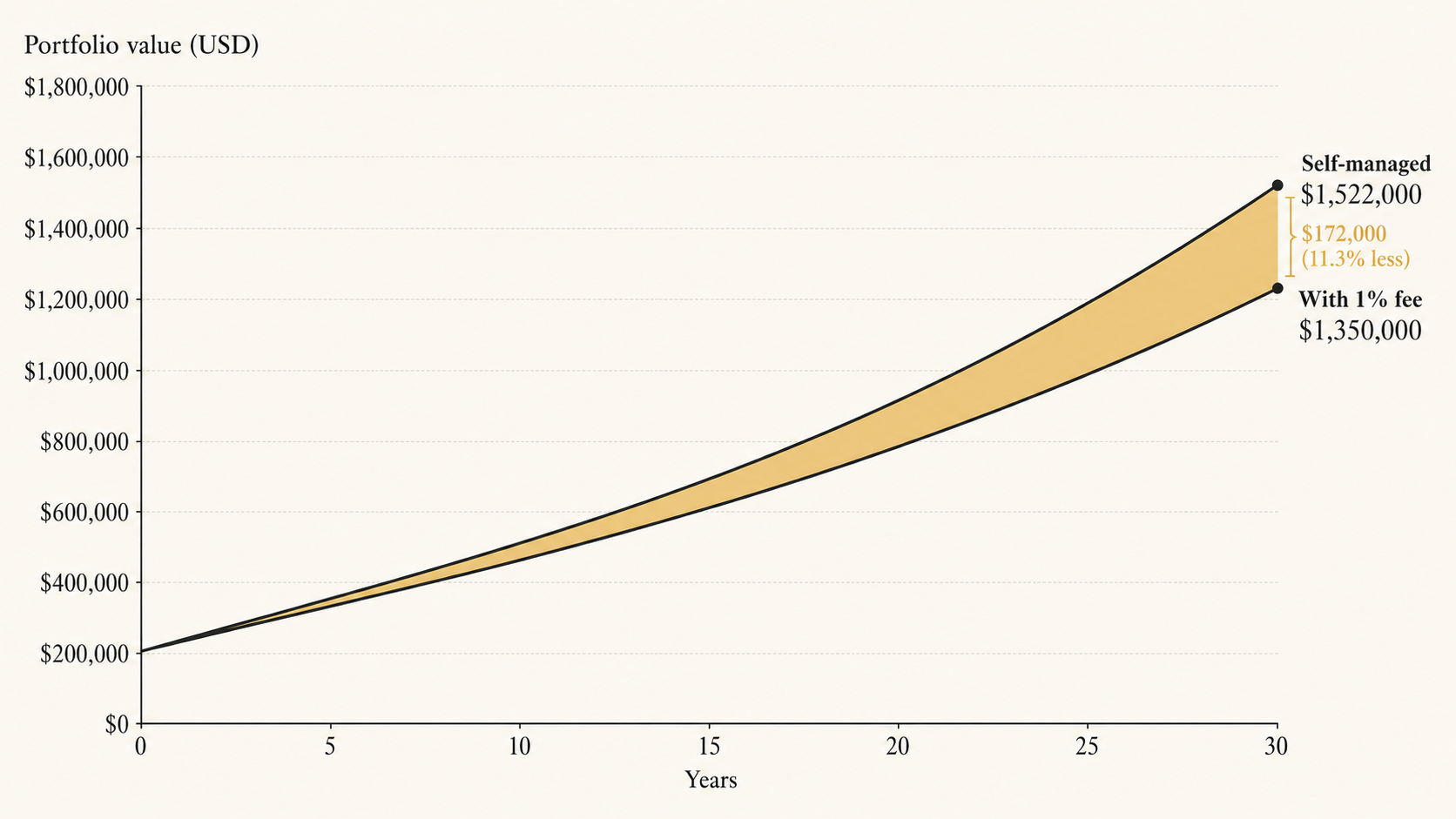
The 1% management fee sounds trivial. On a $200,000 portfolio it’s $2,000 a year — less than a family holiday. But that calculation ignores compounding. A 1% drag over 30 years on $200,000 growing at 7% annually costs approximately $175,000 in terminal wealth. That is not a rounding error. That is a retirement.
But the fee question is only the starting point. The deeper issue is structural: most retail advisers are incentivised to build portfolios that retain clients, not portfolios that maximise returns. Churn is bad for business. Complexity — the kind that makes clients feel they couldn’t manage this themselves — is good for business.
The investors who do best over time are typically not the ones with the most sophisticated advisers. They’re the ones who understood enough about portfolio construction to ask the right questions — and, in many cases, to fire their adviser entirely.
That doesn’t mean self-management is easy. It means the knowledge required is learnable, and most people have never been shown it in a structured way.
What Does “Institutional-Grade Thinking” Actually Mean for a Private Investor?
Institutional fund managers — pension funds, endowments, sovereign wealth funds — approach portfolio construction with a set of tools and disciplines that are rarely discussed in retail investment circles. The core of it is not picking better stocks. It’s managing the portfolio as a system: defining explicit return objectives and risk tolerances, allocating across buckets with different time horizons, stress-testing against adverse scenarios, and reviewing the structure annually rather than the holdings daily.
Howard Marks, co-founder of Oaktree Capital, has written extensively about what separates successful investors from unsuccessful ones. His conclusion is consistent: “The most important thing is understanding where we stand in the market cycle — not timing the market, but knowing what kind of environment you’re operating in.” Most retail investors never think about this at all.
Ray Dalio has made a related point about diversification — that most investors hold what they think is a diversified portfolio but actually have high correlation across assets. The All-Weather framework he popularised is built around genuine risk diversification, not just holding twenty funds instead of five. “The biggest mistake investors make is to believe that what happened in the recent past is likely to persist.”
Neither of these frameworks requires a Bloomberg terminal or a finance degree. They require a clear thinking structure — something that can be written down, revisited, and acted on by any careful investor.
The historical parallel here is instructive. The index fund revolution that began in earnest in the 1980s — driven by evidence from Vanguard’s early research and Jack Bogle’s insistence on cost minimisation — produced a generational transfer of wealth from financial intermediaries to individual investors. The next phase is not another product. It’s a knowledge transfer: giving retail investors the framework to manage their own portfolio intelligently rather than outsourcing it by default.
We are in the middle of that transfer now. ETFs have made low-cost diversification trivially easy. The question is whether investors have the portfolio-level thinking to use those tools well.
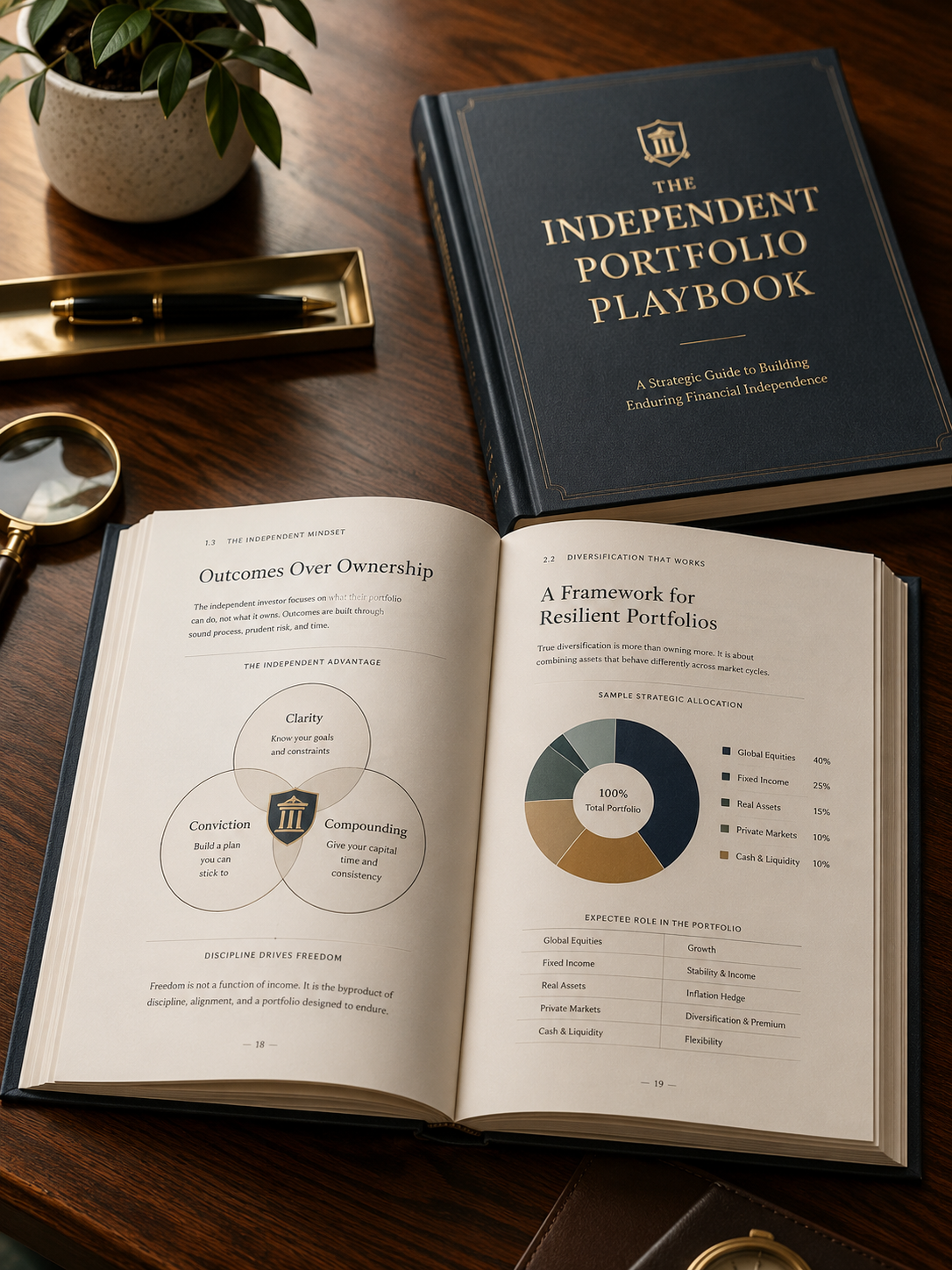
If you want the complete framework — including the multi-bucket allocation model, the fee audit template, and the annual review checklist — the full playbook is available here. It is 168 pages built from two decades of working directly with self-directed investors on exactly these questions.
The most useful thing any self-directed investor can do this year is not to find a better fund. It is to understand how their current portfolio is structured — what the true cost is, what the real risk exposure looks like, and whether the allocation they have matches the one they actually need. That process takes an afternoon with the right framework. Without one, it never gets done at all.
The advisers who charge 1% are not necessarily doing a bad job. Many of them are skilled professionals providing genuine value in behavioural coaching, tax planning, and estate structuring. But for investors who want to manage their own capital — and who are willing to learn the fundamentals properly — the knowledge is available, the tools are accessible, and the cost savings are real.